What This Page Answers, and Who It Is For
An offer letter states one number and a bank statement states another, and the distance between them is rarely explained to the person signing. That distance is made of three things: money the employer spends that never becomes salary, money deducted from salary that stays yours, and money deducted that does not. This page prices all three and shows which is which, so the monthly figure at the end is one you can check rather than one you have to accept.
It is built for the person holding an annual CTC and no idea what survives it. That is a fresher reading a first offer, a switcher weighing two packages that split Basic differently, someone who has just crossed the rebate threshold and cannot work out why a modest raise produced a tax bill, and anyone whose landlord or lender has asked what actually lands each month. If you already know your gross salary, switch the basis at the top of the calculator and the CTC step is skipped.
What this page is not is a payslip. Employers run reimbursements, insurance recoveries, loan instalments, notice-period adjustments and variable pay that no calculator can know about, and a variable component paid annually will make one month look nothing like the other eleven. Treat the monthly figure as the steady-state number your fixed pay produces. For the tax layer on its own, in more depth, the income tax calculator is the right page, and if you want the salary split into its components first, use the salary breakup calculator.
CTC, Gross Salary and In-Hand Salary Are Three Different Numbers
Almost every argument about Indian pay is really a disagreement about which of these three numbers someone means. They are not interchangeable, they never match, and recruiters, payroll teams and job boards each tend to quote a different one.
Written as a formula, in-hand salary equals gross salary minus employee provident fund minus professional tax minus income tax, where gross salary equals CTC minus employer provident fund and any other employer side cost inside the package. One deduction in that list behaves differently from the other two: provident fund leaves your payslip but does not leave your name. It accumulates with interest and you get it back, which is why a package with a high Basic looks worse monthly and is often better over a decade. The provident fund calculator shows what that slice becomes over a career.
Two neighbouring pages own the same arithmetic under different words, so you land where you meant to. Take-home salary is the everyday phrase for what arrives, and post-tax salary is the narrower figure after income tax alone, before provident fund and professional tax. If your starting point is specifically an offer-letter CTC and you want the conversion framed that way, the CTC to in-hand salary calculator is the sibling page.
How This In-Hand Salary Calculator Works Out Your Monthly Pay
The engine runs seven steps in a fixed order, and reordering any of them changes the answer. It reads your figure and its basis, removes employer provident fund if you entered a CTC, subtracts the deductions the chosen regime allows to reach taxable income, walks that income through every slab, applies the Section 87A rebate with marginal relief, adds surcharge where it is due and then 4% Health and Education Cess, and finally takes income tax, your own provident fund and professional tax off gross salary. The slabs below are the ones it applies under the New Regime for the current financial year.
| Taxable Income Slab | Rate | Maximum Tax in the Slab |
|---|---|---|
| Up to ₹4,00,000 | Nil | Nil |
| ₹4,00,001 to ₹8,00,000 | 5% | ₹20,000 |
| ₹8,00,001 to ₹12,00,000 | 10% | ₹40,000 |
| ₹12,00,001 to ₹16,00,000 | 15% | ₹60,000 |
| ₹16,00,001 to ₹20,00,000 | 20% | ₹80,000 |
| ₹20,00,001 to ₹24,00,000 | 25% | ₹1,00,000 |
| Above ₹24,00,000 | 30% | Uncapped |
Three things sit on top of that table. The standard deduction of ₹75,000 for salaried taxpayers comes off gross salary before any slab is touched. The Section 87A rebate then removes tax entirely where taxable income is ₹12,00,000 or less, to a maximum of ₹60,000, which is exactly the slab tax at that income. Health and Education Cess at 4% is added to whatever tax survives. Together they produce a threshold worth remembering: ₹12,75,000 of gross salary carries no income tax at all, and at this tool's default split that is a CTC of about ₹13,56,000. Rates, the rebate and the filing forms that use them are published by the Income Tax Department, and its ITR-1 (Sahaj) filing guide is the official reference for the salaried filer who will eventually report these numbers.
Two deductions on this page are not income tax at all and behave by their own rules. Employee provident fund is 12 percent of Basic in most private structures, statutorily compulsory on the first ₹15,000 of monthly Basic and voluntarily applied to the whole of it by most employers, which is the higher method this calculator follows. Professional tax is a state levy, capped at ₹2,500 for the year by Article 276(2) of the Constitution, charged only by the states that have enacted it, and deductible from taxable income under the Old Regime only. The professional tax calculator covers the state slabs in detail.
Which Regime Leaves More in Your Hand
The regime decides your income tax, and income tax is one of the three deductions between gross salary and your bank account, so the choice moves your monthly credit directly. Switch the toggle in the calculator and the result names the annual rupee gap between the two on your own numbers rather than on an average.
- Seven bands, nil up to ₹4,00,000
- Standard deduction of ₹75,000
- No HRA exemption, no 80C, no 80D
- Professional tax is not deductible
- Zero tax up to ₹12,00,000 of taxable income
- Surcharge caps at 25 percent
- Four bands, nil up to ₹2,50,000
- Standard deduction of ₹50,000
- HRA, 80C, 80D, LTA and NPS all count
- Professional tax is deductible under section 16(iii)
- Zero tax up to ₹5,00,000 of taxable income
- Surcharge runs to 37 percent
The honest limit, stated plainly: the Old Regime column here claims the standard deduction, professional tax, the HRA exemption on whatever rent you enter, and 80C on your own provident fund. It does not claim 80D health premiums, home loan interest, LTA, or any 80C investment beyond provident fund, because the tool does not ask for them and will not assume them. If you carry those, your real Old Regime tax is lower than the figure shown and the gap narrows. That fuller comparison is a different calculation with its own inputs, and it lives on the old versus new tax regime calculator.
Rent is worth entering if you pay it. On a ₹15,00,000 CTC at the default split, with ₹25,000 of monthly metro rent, the section 10(13A) exemption comes to ₹2,25,000 and Old Regime tax falls from ₹2,01,240 to ₹1,31,040, a saving of ₹70,200 a year. That still loses to the New Regime figure of ₹83,460 on those inputs, but it is the sort of margin that flips once 80D and home loan interest are added, which is exactly why the dedicated comparison page exists.
In-Hand Salary at Common CTC Levels
The most useful thing this table shows is not any single row but the trend down the last column. The share of your package that reaches your bank falls steadily as the package rises, because the slabs are progressive and provident fund scales with Basic while the rebate does not scale at all.
| Annual CTC | Monthly Gross | Annual Income Tax | Monthly In-Hand | Effective Tax Rate | In-Hand as % of CTC |
|---|---|---|---|---|---|
| ₹6,00,000 | ₹47,000 | ₹0 | ₹44,000 | 0.00% | 88.0% |
| ₹9,00,000 | ₹70,500 | ₹0 | ₹66,000 | 0.00% | 88.0% |
| ₹12,00,000 | ₹94,000 | ₹0 | ₹88,000 | 0.00% | 88.0% |
| ₹15,00,000 | ₹1,17,500 | ₹83,460 | ₹1,03,045 | 5.92% | 82.4% |
| ₹20,00,000 | ₹1,56,667 | ₹1,67,440 | ₹1,32,713 | 8.91% | 79.6% |
| ₹30,00,000 | ₹2,35,000 | ₹4,19,640 | ₹1,85,030 | 14.88% | 74.0% |
| ₹50,00,000 | ₹3,91,667 | ₹10,06,200 | ₹2,82,817 | 21.41% | 67.9% |
New Regime, Basic at 50 percent of CTC, provident fund at 12 percent on both sides, no professional tax and no rent claimed. Every row was computed by the calculator on this page. Change any of those assumptions and your own figure will differ, which is what the tool above is for.
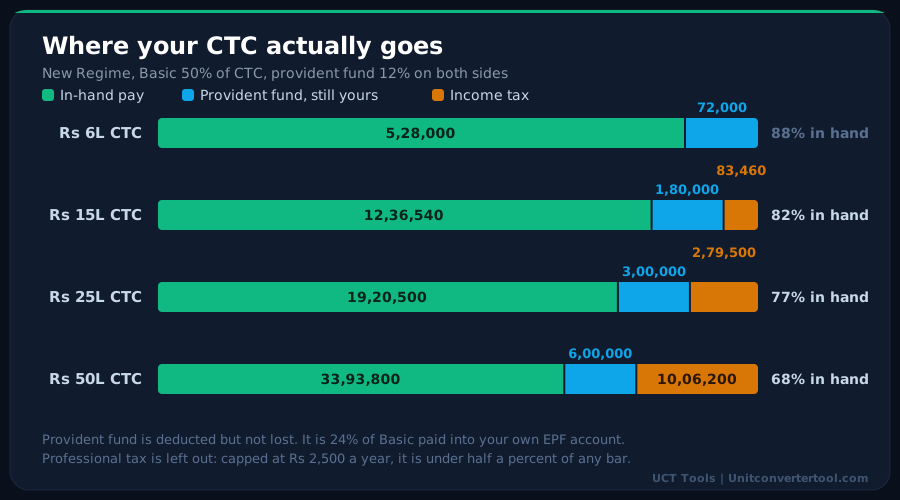
The same rows drawn as shares. The blue band is the part people miscount: provident fund leaves your payslip but not your name, so at ₹6,00,000 CTC nothing at all is actually lost to tax. Only the amber band is gone for good, and it does not appear until the package passes roughly ₹13,56,000. None of these four levels reaches the surcharge threshold, which applies above ₹50,00,000 of taxable income rather than of CTC.
Notice that the first three rows are identical at 88.0 percent and carry no tax at all. Below roughly ₹13,56,000 of CTC at this split, the whole gap between package and pay is provident fund on both sides plus professional tax, and half of that gap is money you keep. Tax only becomes the dominant deduction above that line. If you are working out what a raise is actually worth, the salary increment calculator models the jump, and for pay quoted by the hour or by invoice the hourly to salary converter and the freelance income calculator are the right starting points, since neither carries a standard deduction the way salaried pay does.
Technical Notes and Honest Limits
The short version, before the detail: this is a statutory slab engine sitting on top of a conventional salary structure, not a reader of your payslip and not a substitute for your Form 16. Where it assumes something or stops short, it says so here.
The tool builds Basic from the percentage you give and derives HRA and provident fund from that Basic. Real letters vary: some fix Basic in rupees, some carry a dearness allowance, some load a large variable component that is paid annually rather than monthly, and some include the gratuity provision inside CTC where this tool does not. If your letter lists a gratuity provision separately inside the package, subtract it before entering the CTC, or start from the salary breakup calculator which models it explicitly.
Just above the rebate ceiling, tax before cess is capped at the amount by which taxable income exceeds ₹12,00,000, so the rebate does not fall off a cliff. One consequence looks like a bug and is not: inside that band, annual net income falls as gross rises. Relief caps the tax at the income earned above the ceiling and 4 percent cess is then charged on that capped tax, so every extra rupee costs four paise of net. Measured on this engine, the dip runs from ₹12,00,000 of taxable income to a deepest point of ₹12,70,588, where net is ₹2,824 lower, and net returns to its ₹12,00,000 level at ₹12,73,934. Do not read a small drop there as an error in the tool.
Above ₹50,00,000 of taxable income the engine applies surcharge at 10, 15 and 25 percent as the thresholds are crossed, with its own separate marginal relief at each one, and the New Regime cap of 25 percent rather than the Old Regime's 37. What it cannot model is everything else that arrives at that level: perquisites, ESOP exercises, capital gains and variable pay all change the picture and none of them is a salary structure input. The result says so on screen once you cross the line, and the income tax calculator is the page that owns surcharge in full.
It claims the ₹50,000 standard deduction, professional tax under section 16(iii), the HRA exemption under section 10(13A) on the rent you enter, and 80C limited to your own provident fund contribution within the ₹1,50,000 ceiling. It does not claim 80D health premiums, home loan interest, LTA, tuition fees or any other 80C investment, because the tool does not ask for them and inventing a deduction nobody claimed would overstate your take-home. The New Regime column claims the ₹75,000 standard deduction and nothing else, which is correct under section 115BAC.
Your employer deducts tax at source on a projection of your full-year income and revises it every month as declarations, perquisites and actual payouts land, which is why the deduction usually jumps in the final quarter. It also applies whichever regime you declared, which may not be the one selected here. On top of that sit reimbursements, insurance recoveries and any loan instalment your employer runs, none of which is income tax. This tool computes the correct annual position on the figures you typed. Your Form 16 is the authority on what was actually deducted.
Slab tax and cess are rounded to whole rupees once, at the end, and the monthly figure is the annual figure divided by twelve. Real payroll is never that even. Slabs, the rebate ceiling and the standard deduction are set by the Finance Act and can move at any Budget; this engine is updated when they do, but verify the current assessment year before acting on a number, especially close to a Budget. Nothing here is tax advice, and for a decision with real money behind it a chartered accountant is worth the fee.